Artificial Intelligence (AI) is changing the way businesses work. Today, AI tools can help people write blog posts, create social media content, run advertisements, and understand customer behaviour.
Because of this, many people have an important question: Can AI replace digital marketers?
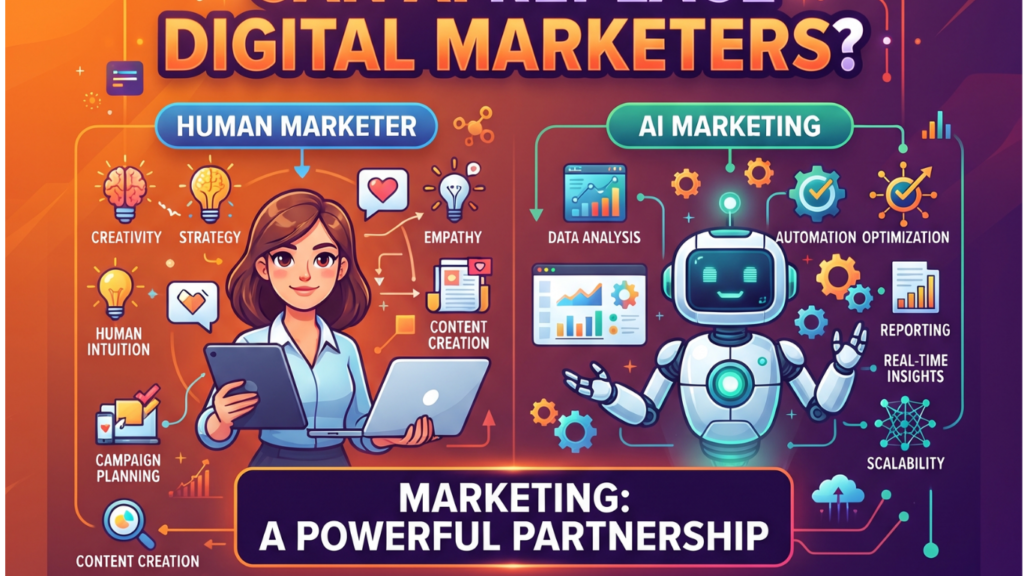
Earlier, many of these tasks took hours to complete. Now, AI can help finish some of them in just a few minutes.
The simple answer is that AI can do many marketing tasks, but it cannot easily replace everything a human digital marketer does.
Digital marketing is not only about writing content or running advertisements. It is also about understanding customers, creating new ideas, planning campaigns, and helping businesses grow.
In this article, we will explain how AI is changing digital marketing, whether marketing jobs are at risk, and how businesses and beginners can prepare for the future.
Want to learn more? Visit the Snowolive to explore our digital marketing services.
1. What Is AI in Digital Marketing?
AI in digital marketing means using artificial intelligence tools to make marketing work easier and faster.
For example, imagine you own a clothing store and want to promote your products online. You need Instagram posts, advertisements, product descriptions, and website content.
Instead of creating everything from the beginning, you can use AI tools to generate ideas, write content drafts, and suggest ways to promote your products.
However, you still need to decide which products to promote, who your customers are, and how to convince people to buy from your store.
This is where a digital marketer becomes important.
AI can help with many marketing activities, such as:
- SEO: Finding keywords and improving website content.
- Social Media Marketing: Creating post ideas and captions.
- Google Ads and Meta Ads: Writing advertisements and analyzing campaign results.
- Email Marketing: Preparing emails for customers.
- Content Marketing: Helping create blogs, articles, and website content.
- Data Analysis: Understanding website visits, clicks, and sales.
- Customer Support: Answering common customer questions through chatbots.
AI can make these tasks easier, but businesses still need a clear marketing plan to get good results.
2. How Is AI Changing Digital Marketing?
AI is changing how digital marketers work. It helps them complete some tasks faster and spend more time on important activities.
Let’s understand this with a few simple examples.
Faster Content Creation
Writing social media posts, blogs, and advertisements takes time. AI can help marketers create drafts and generate new ideas quickly.
For example, if a bakery wants to promote its cakes on Instagram, AI can suggest post ideas about birthday cakes, special offers, new flavours, and customer reviews.
The digital marketer can then choose the best ideas and make the content more interesting.
This saves time and makes content planning easier.
Better Advertising
Businesses use Google Ads and Meta Ads to reach potential customers.
AI can help create different advertisement headlines, study campaign results, and suggest ways to improve performance.
For example, if an advertisement gets many clicks but very few enquiries, the marketer can check whether the offer, audience, or website needs improvement.
AI can help identify possible problems, but the marketer must decide what changes to make.
Understanding Customers
Every business wants to understand what its customers need.
AI can help study customer feedback, website activity, and advertising data to find common patterns.
For example, if many customers ask about delivery charges before buying a product, the business can display delivery information more clearly on its website.
This can make the buying process easier for customers.
Saving Time Through Automation
Some marketing tasks are repetitive, such as scheduling posts, preparing reports, and sending follow-up emails.
AI-powered tools can help automate these tasks.
As a result, marketers can spend more time planning campaigns, understanding customers, and improving business results.
3. What Can AI Do Better Than Human Digital Marketers?
AI has several advantages that make it useful for businesses.
1. It Works Quickly
AI can generate many content ideas, captions, and advertisement headlines in a short time.
For example, a marketer can ask AI to suggest 20 Instagram post ideas for a clothing brand instead of thinking of every idea manually.
The marketer can then select and improve the most useful suggestions.
2. It Can Analyze Large Amounts of Data
AI can help marketers understand information from websites and advertising campaigns.
It can help identify which advertisements receive more clicks, which pages attract visitors, and where customers may leave a website.
This information helps marketers decide what they should investigate or improve.
3. It Helps Automate Repetitive Tasks
AI tools can help with regular tasks such as preparing reports, drafting emails, and organizing information.
This allows marketers to focus on more important work.
4. It Can Suggest New Ideas
Sometimes, people run out of ideas for social media posts or marketing campaigns.
AI can suggest different topics, offers, and content formats.
For example, a gym can use AI to generate ideas about beginner workouts, common exercise mistakes, fitness tips, and healthy habits.
The gym’s marketing team can then choose ideas that suit its customers.
However, AI is only a tool. Its suggestions need to be checked before they are used.
4. What Can AI Not Replace Easily?
AI is useful, but some parts of digital marketing still need human thinking and understanding.
Human Creativity
AI can suggest ideas, but businesses need content that makes them different from their competitors.
For example, two clothing brands may sell similar products. One may focus on affordable fashion, while the other may focus on premium designs.
Both brands need different marketing messages to attract their customers.
A digital marketer helps create these messages and gives the brand its own identity.
Understanding Customer Feelings
People do not always buy products because they are cheap. They also consider trust, quality, convenience, and their personal needs.
For example, someone may avoid buying from a new online store because they are worried about product quality.
The business may need to display genuine customer reviews, provide clear return policies, and share accurate product information.
A marketer needs to understand the customer’s problem and find the right way to address it.
Making Business Decisions
AI can suggest marketing ideas, but it cannot automatically make every decision correctly.
A business needs to decide whether it should focus on increasing sales, getting more enquiries, attracting website visitors, or building brand awareness.
These goals depend on the business’s budget, customers, products, and current situation.
A digital marketer helps create a plan based on these needs.
Building Customer Relationships
Customers want businesses to listen to them and solve their problems.
AI chatbots can answer common questions, but some situations need personal attention.
For example, a customer with a complicated complaint may need to speak with a real person.
Building trust and maintaining good customer relationships remain important parts of marketing.
5. AI vs. Human Digital Marketers
Here is a simple comparison of how AI and human marketers work.
| Task | AI Can Help With | Human Marketers Can Help With |
|---|---|---|
| Content writing | Writing initial drafts | Adding creativity and brand personality |
| SEO | Finding keywords | Planning website improvements |
| Advertising | Suggesting headlines and analyzing data | Choosing goals and improving campaigns |
| Social media | Generating post ideas | Understanding the audience |
| Email marketing | Drafting and automating emails | Building customer relationships |
| Data analysis | Finding patterns | Making decisions based on results |
| Customer service | Answering common questions | Solving complicated problems |
Both AI and human marketers have their own strengths.
When they work together, businesses can save time while maintaining the quality of their marketing.
6. Will AI Replace Digital Marketing Jobs?
Many students and working professionals worry that AI will reduce digital marketing jobs.
The truth is that AI may change some jobs, especially those that involve repetitive tasks. However, it does not mean that all digital marketing jobs will disappear.
For example, businesses may use AI to write the first draft of a social media caption. But they still need someone to plan the content, check the information, understand the audience, and measure the results.
Similarly, AI can help prepare advertising reports, but someone needs to understand what those reports mean for the business.
Which Skills Should Digital Marketers Learn?
Digital marketers can prepare for the future by learning useful skills such as:
- SEO and keyword research
- Google Ads and Meta Ads
- Social media management
- Website design
- Content writing and planning
- Data analysis
- AI tools and marketing automation
- Communication and creative thinking
For example, a person who knows how to run advertisements and understand sales data can help a business improve its marketing strategy.
This is more valuable than simply knowing how to create an advertisement.
The future is not just about using AI. It is about knowing how to use AI to solve real business problems.
7. How Can Beginners Start a Career in Digital Marketing?
If you are a student or beginner, you can still build a career in digital marketing. The important thing is to learn the basics and practise your skills.
Here are some simple steps to follow.
Step 1: Learn Digital Marketing Basics
First, understand how digital marketing works.
Learn how businesses promote their products and services online, attract visitors, generate leads, and increase sales.
Start with SEO, social media marketing, paid advertising, email marketing, and content marketing.
Step 2: Learn SEO
SEO stands for Search Engine Optimization. It helps businesses improve their website’s visibility in search engines such as Google.
For example, if someone searches for “best bakery in Rohini,” a bakery with a well-optimized website may have a better chance of appearing in relevant search results.
To learn SEO, start with Google’s official SEO Starter Guide.
It explains how to make website content easier for search engines and visitors to understand.
Step 3: Learn Google Ads and Meta Ads
Google Ads can help businesses reach people searching for products or services. Meta Ads can help businesses promote themselves on Facebook and Instagram.
Learn how to select an audience, prepare advertisements, set budgets, and measure results.
Remember that getting clicks does not always mean getting sales. You should also understand how many enquiries or purchases a campaign generates.
Step 4: Practise Using AI Tools
Try using AI to create content ideas, draft advertisements, plan blog topics, and organize marketing tasks.
For example, you can ask AI to prepare five advertisement headlines for a local clothing store.
Then improve those headlines by considering the store’s products, prices, customers, and special offers.
This will help you understand how AI can support your work.
Step 5: Create a Portfolio
A portfolio is a collection of examples that shows your skills.
You can create a sample social media calendar, prepare an SEO plan for a local business, design a landing page, or create a sample advertising campaign.
Explain what you wanted to achieve and how you planned to do it.
If the work is a practice project, clearly identify it as a sample project.
Step 6: Keep Learning
Digital marketing tools and customer behaviour change over time.
Keep practising, learn from your mistakes, and stay updated with new tools and marketing methods.
You do not need to learn everything in one day. Start with one skill, practise it, and gradually move to the next.
8. How Can Small Businesses Use AI for Marketing?
AI is especially helpful for small businesses that have limited budgets and small teams.
Let’s understand how different businesses can use it.
Clothing Stores
A clothing store can use AI to generate Instagram post ideas, prepare product descriptions, and write promotional captions.
The business can then decide which products and offers to promote.
Restaurants and Cafes
Restaurants can use AI to plan social media content, write promotional messages, and prepare answers to common customer questions.
However, menu details, prices, and opening hours should always be checked before publishing.
Salons and Coaching Centres
A salon can use AI to generate content about beauty tips and services. A coaching centre can use it to plan educational posts and answer common questions.
With a clear marketing strategy, this content can help businesses connect with potential customers.
Online Stores
Online stores can use AI to prepare product descriptions, organize customer feedback, and generate content ideas.
However, all product information must be correct. AI should not be allowed to create false claims about products or services.
The main purpose of using AI is to save time and improve marketing activities, not to produce content without a plan.
9. How Can Snowolive Help Your Business Grow Online?
Using AI tools is helpful, but businesses also need a clear plan to reach the right customers and achieve their goals.
Snowolive helps businesses grow their online presence through SEO, website design, Google Ads, Meta Ads, e-commerce solutions, and email marketing.
For example, if you own a small business and want more enquiries, you may need a better website, useful content, and advertisements that reach the right audience.
If your website receives visitors but very few people contact you, you may need to improve the website’s design, explain your services more clearly, or make your contact details easier to find.
Similarly, if your social media posts receive likes but do not bring customers, you may need a better content strategy and a clear way to turn interested people into enquiries.
AI can help with research, content ideas, and data analysis. However, these tools work best when they are used as part of a proper marketing plan.
Snowolive aims to help businesses use digital marketing to improve their online visibility, connect with potential customers, and work towards their business goals.
Want to learn more? Visit the Snowolive website to explore our digital marketing services.
10. Does AI Affect SEO and Google Rankings?
Many people think that AI will completely change SEO or make it unnecessary. However, SEO remains important for businesses that want people to discover their websites through search engines.
AI is changing how search engines present information, but websites still need useful content and a good user experience.
Google’s guide to AI features in Search explains how existing SEO practices remain relevant to its AI-powered search experiences.
Here are some simple SEO tips for your website.
Write Useful Content
Your content should answer the questions people are actually asking.
For example, if you run a digital marketing agency, you can write articles about SEO, online advertising, website design, and marketing tips for small businesses.
Use Keywords Naturally
Keywords help search engines understand what your page is about.
However, do not repeat the same keyword in every sentence. Use it naturally in the title, headings, introduction, and other relevant places.
Make Your Website Easy to Use
Visitors should be able to find information without difficulty.
Use clear headings, readable text, useful images, and a simple website structure. Make sure your website works well on mobile phones.
Check AI-Generated Content
AI can sometimes provide incorrect information or repeat common ideas.
Always review your content, check important facts, and add useful examples or insights.
Google’s official guidance on AI-generated content explains why content quality and usefulness matter when using AI.
Add Internal and External Links
Internal links connect one page of your website to another. For example, a blog about AI in digital marketing could link to your own article about SEO.
External links direct readers to useful information on other websites, such as official Google guides.
These links can help readers explore a topic in more detail.
Remember, no tool or SEO technique can guarantee a particular Google ranking.
11. Common Mistakes to Avoid When Using AI
AI can make marketing easier, but using it incorrectly can create problems.
Publishing Content Without Checking It
AI can make mistakes, provide outdated information, or create statements that are not true.
Always read and check your content before publishing it.
Copying the Same Content Everywhere
Every social media platform has a different audience and style.
Instead of posting exactly the same message everywhere, adjust the content to suit the platform and the people you want to reach.
Ignoring Your Customers
Do not create content only because an AI tool suggests it.
First, understand what your customers want to know, what problems they face, and how your business can help them.
Depending Completely on AI
AI should support your work, not make every decision for you.
Use your own understanding, customer feedback, and business knowledge to decide whether an idea is useful.
Focusing Only on Likes and Clicks
Getting likes and website visits is good, but these numbers do not always mean that your business is growing.
Also check enquiries, sales, conversion rates, and customer retention, depending on your business goals.
12. What Is the Future of Digital Marketing?
The future of digital marketing will likely involve more AI tools and automation.
Marketers may spend less time on repetitive tasks and more time understanding customers, planning campaigns, creating better strategies, and improving results.
For example, AI may help prepare different versions of an advertisement. A human marketer can then choose the most suitable version, check the message, launch the campaign, and study the results.
Businesses will continue to need people who understand their customers and know how to turn marketing activities into meaningful business outcomes.
At the same time, digital marketers will need to keep learning because tools and customer expectations will continue to change.
No one can predict exactly how every marketing job will develop. However, learning marketing basics, using AI responsibly, and gaining practical experience are useful ways to prepare.
Frequently Asked Questions (FAQs)
1. Can AI completely replace digital marketers?
AI can handle many tasks, such as drafting content, researching keywords, and analyzing data. However, businesses still need people for strategy, creative decisions, customer understanding, and quality checks.
2. Is digital marketing a good career in the AI era?
Digital marketing can be a good career choice for people who enjoy creativity, technology, and business. Learning AI tools alongside SEO, advertising, analytics, and content strategy can help you develop useful skills.
3. Which digital marketing skills should I learn first?
Start with the basics of SEO, social media marketing, content creation, and paid advertising. Once you understand these areas, learn analytics and AI tools to improve your work.
4. Can small businesses use AI for free?
Some AI tools offer free plans or limited free features. These can help small businesses generate ideas, draft content, and plan marketing activities. Always check the current features and usage limits of each tool.
5. Can AI-generated content rank on Google?
AI-generated content can appear in search results if it is useful, accurate, and meets Google’s policies. Simply using AI does not guarantee higher rankings.
6. Should I learn AI if I want to become a digital marketer?
Yes, learning relevant AI tools can help you work more efficiently. However, you should also understand marketing fundamentals so you can use these tools correctly.
Conclusion: Can AI Replace Digital Marketers?
AI is changing digital marketing by making content creation, research, data analysis, and repetitive tasks faster.
However, marketing is not just about creating posts or running advertisements. It is also about understanding customers, planning campaigns, building trust, and helping businesses achieve their goals.
AI can support these activities, but it still needs human guidance and careful checking.
Businesses can benefit by combining AI tools with a good marketing strategy. Students and professionals can prepare for the future by learning digital marketing skills and understanding how AI works.
If you own a business, you can start by using AI to save time and improve your marketing process. If you want to become a digital marketer, focus on learning practical skills and gaining experience.
The future is not simply AI versus digital marketers. It is about how people and AI can work together to create better marketing results.