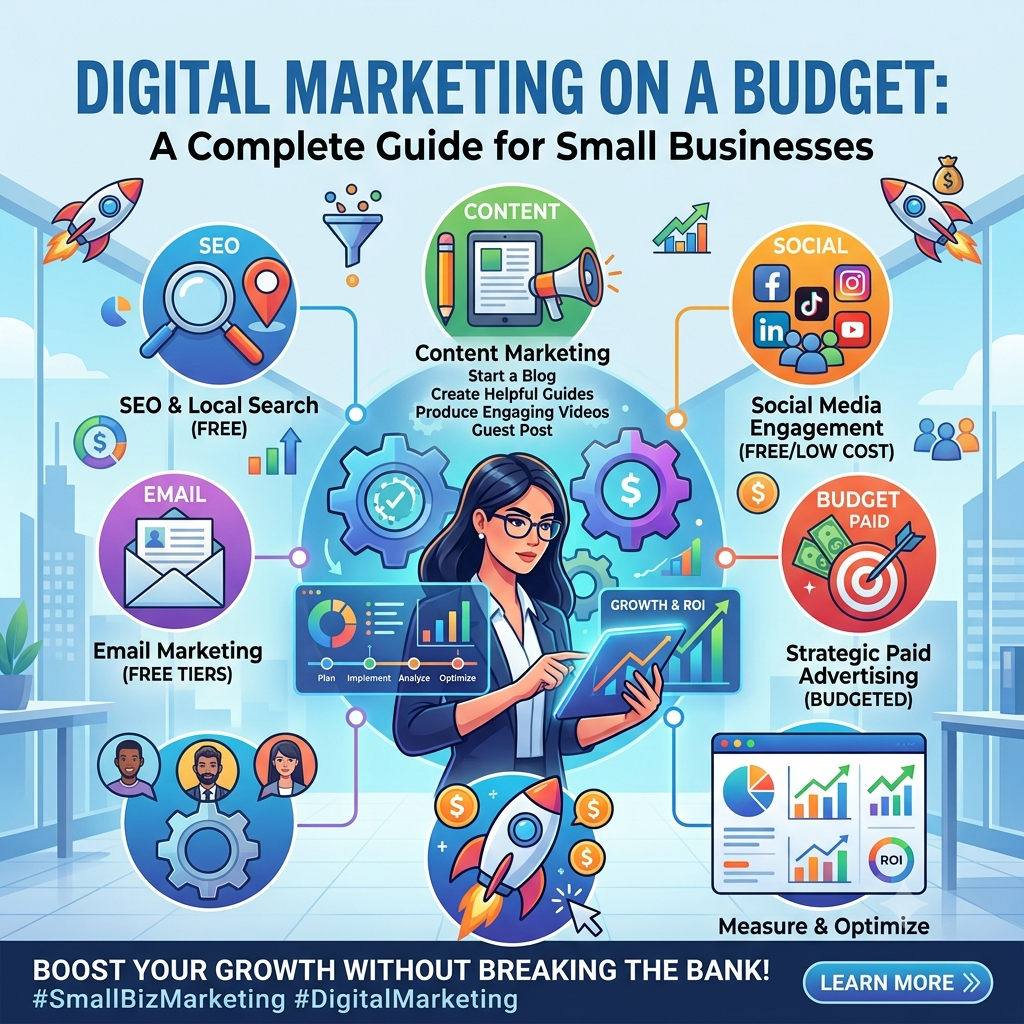
Running a small business is not easy. You have to manage products, customers, expenses, and sales every day. At the same time, you want more people to know about your business and buy your products or services.
But what if you have a limited marketing budget?
The good news is that you do not need a big budget to grow your business online. With the right digital marketing strategy, you can reach potential customers, build trust, and increase sales without spending too much money.
In this guide, we will explain how small businesses can use digital marketing on a budget, which platforms are worth trying, and how to get better results from their marketing efforts.
Want to grow your business online? Visit Snowolive to explore digital marketing services, including website design, SEO, Google Ads, and social media marketing.
Why Is Digital Marketing Important for Small Businesses?
Traditional marketing methods, such as newspaper advertisements, banners, and pamphlets, can be expensive. Digital marketing gives small businesses more ways to reach their target audience with a limited budget.
Here are some important benefits.
1. Reach more potential customers
Your business can reach people beyond your local area, depending on your products and services.
2. Build trust with customers
Regular posts, customer reviews, useful information, and a professional website help people understand your business and feel more confident buying from you.
3. Start with a small budget
You can begin with free social media accounts, Google Business Profile, and basic SEO before investing in advertisements.
4. Understand your results
Digital marketing tools can help you track website visits, customer enquiries, clicks, and conversions. This helps you understand what is working and what needs improvement.
5. Compete with larger businesses
A small business can attract customers by sharing useful content, offering good service, and targeting the right audience instead of trying to outspend larger competitors.
7 Budget-Friendly Digital Marketing Strategies for Small Businesses
You do not need to use every marketing method at once. Start with the strategies that best match your business and your customers.

1. Use Social Media Marketing
Social media is one of the easiest ways to introduce your business to potential customers without paying for advertisements.
Platforms like Instagram, Facebook, and LinkedIn can help you share your products, explain your services, and build relationships with your audience.
What can you post?
- Product photos and videos
- Behind-the-scenes content
- Customer reviews and feedback
- Helpful tips related to your business
- Frequently asked questions
Budget tip: Start with one or two platforms where your target customers are active. Post consistently instead of trying to be everywhere.

2. Create a Google Business Profile
If you own a local business, such as a salon, restaurant, coaching centre, clothing shop, or marketing agency, a Google Business Profile can help people discover you on Google Search and Maps.
Add your correct business name, address or service area, phone number, business hours, photos, and services.
Encourage genuine customers to leave reviews and respond politely to their feedback.
Budget tip: Creating a Google Business Profile is free. Keep your information updated so potential customers can easily contact you.

3. Improve Your Website SEO
Search engine optimization, or SEO, helps your website appear in relevant search results.
For example, if you sell handmade jewellery in Delhi, you might create useful pages around searches such as “handmade jewellery in Delhi” or “affordable handmade gifts.”
Start with these simple steps:
- Use relevant keywords naturally in your content.
- Write clear page titles and descriptions.
- Make your website mobile-friendly.
- Publish useful articles that answer customer questions.
- Add clear contact details and service information.
Budget tip: You can learn basic SEO and make many improvements yourself. However, SEO takes time, and higher rankings are never guaranteed.

4. Create Useful Content
Content marketing means sharing helpful information that attracts people who may need your products or services.
You can create Instagram Reels, blog posts, short videos, guides, or infographics without hiring a large team.
For example:
- A clothing store can share outfit ideas.
- A bakery can post cake decoration videos.
- A digital marketing agency can explain common advertising mistakes.
- A fitness trainer can share beginner-friendly exercise tips.
Budget tip: Use free or low-cost design tools and your smartphone. One useful topic can become a Reel, a carousel post, and a blog article.

5. Try Email Marketing
Email marketing helps you stay connected with people who have chosen to receive updates from your business.
You can send new product announcements, helpful tips, special offers, newsletters, and updates about your services.
Keep your emails useful and easy to read. Avoid sending too many messages, and always respect people’s consent and unsubscribe requests.
Budget tip: Start with a small list of interested customers and check the free plans offered by email marketing platforms. Their limits and features may change.

6. Run Small Paid Advertising Campaigns
If you want faster visibility, you can test paid advertisements on Google, Facebook, or Instagram.
Google Ads can help you reach people actively searching for certain products or services. Social media ads can help introduce your business to a relevant audience.
Before spending money, decide what you want to achieve: website visits, phone calls, enquiries, or purchases.
Budget tip: Start with a small test budget you can afford to lose. Test one audience and a few creative variations, then review the results before increasing your spending.

7. Use WhatsApp to Build Customer Relationships
For many small businesses in India, WhatsApp is a convenient way to answer questions and manage customer enquiries.
You can use WhatsApp Business to share a business profile, organise conversations, display a catalogue where appropriate, and provide customer support.
Reply clearly, share useful information, and make it easy for interested customers to take the next step.
Budget tip: Start with the free WhatsApp Business app and use it to manage conversations more professionally. Follow WhatsApp’s rules and obtain appropriate consent before sending promotional messages.
How Much Budget Do You Need for Digital Marketing?
There is no single budget that works for every business. Your expenses depend on your industry, competition, location, goals, and whether you manage marketing yourself or hire a professional.
Here is an illustrative monthly budget in Indian rupees for planning purposes, not a guarantee of results.
| Budget level | What you can focus on |
|---|---|
| ₹0–₹2,000 | Organic social media, basic SEO, Google Business Profile, and DIY content |
| ₹2,000–₹5,000 | Better content creation, selected tools, and small advertising tests |
| ₹5,000–₹10,000 | More consistent content, paid campaign testing, and basic reporting |
| ₹10,000+ | Broader advertising tests, professional support, and additional marketing tools |
These estimates exclude major website development costs and may not cover agency fees. Advertising budgets should be planned separately from design, website, and management expenses.
Remember: Spending more does not automatically mean getting more customers. A clear strategy and the right audience are more important than a large budget.
How to Create a Digital Marketing Plan on a Budget
A common mistake small businesses make is trying several marketing methods without deciding what they want to achieve.
Follow these five steps to create a simple plan.
Step 1: Set a clear goal
Decide whether you want more enquiries, website visits, local customers, or online sales. Choose one main goal to start.
Step 2: Understand your target audience
Think about your ideal customer, their needs, their location, and the problems your business can solve.
Step 3: Choose suitable platforms
Select one or two platforms based on where your audience spends time and how they search for your products or services.
Step 4: Set a realistic budget
Decide how much you can comfortably spend each month. Start with free activities before paying for tools, ads, or outside support.
Step 5: Measure your results
Track enquiries, sales, website visits, customer acquisition costs, and the performance of your content. Continue with what works and improve what does not.
A Simple 30-Day Digital Marketing Plan for Beginners
If you are new to digital marketing, you do not need a complicated strategy. Use this beginner-friendly 30-day plan to get started.
Week 1: Build Your Foundation
Days 1–7
- Define your target audience.
- Update your social media profiles.
- Create or update your Google Business Profile if eligible.
- Review your website and contact information.
Week 2: Start Creating Content
Days 8–14
- Create three helpful social media posts.
- Publish one short video or Reel.
- Share product details, useful tips, or answers to common questions.
- Respond to comments and customer messages.
Week 3: Improve Your Online Visibility
Days 15–21
- Improve one important website page.
- Research keywords your customers might search for.
- Publish one useful blog post or guide.
- Ask satisfied customers for honest reviews.
Week 4: Review and Improve
Days 22–30
- Check which posts attracted the most attention.
- Review enquiries and sales.
- Identify the most common customer questions.
- Decide which activities to continue next month.
You can complete this plan without paid advertising. If you have some money available, consider testing a small campaign after you have a clear offer and a way to measure results.
Free and Affordable Digital Marketing Tools
You do not need expensive software to begin. These tools can help you manage important marketing activities.

Canva — Content Design
Create social media posts, presentations, flyers, and basic marketing designs using its free plan.
Canva — Content Design
Create social media posts, presentations, flyers, and basic marketing designs using its free plan.
Website: canva.com

Google Analytics — Website Performance
Understand how people use your website, which pages they visit, and how they interact with your content.
Website: analytics.google.com

Google Search Console — SEO Monitoring
Check how your website performs in Google Search and identify search queries that bring people to your pages.
Website: search.google.com/search-console

Meta Business Suite — Social Media Management
Manage eligible Facebook and Instagram business accounts, schedule content, and review available insights.
Website: business.facebook.com

Google Trends — Topic Research
Explore search interest and compare topics to discover what people are searching for.
Google Trends — Topic Research
Explore search interest and compare topics to discover what people are searching for.
Website: trends.google.com
Some tools offer paid upgrades, and certain features may require setup or eligibility. Start with the free features and upgrade only when you have a clear reason.
5 Common Digital Marketing Mistakes to Avoid
Even with a small budget, you can waste money if you do not have a clear plan. Avoid these common mistakes.
1. Trying to reach everyone
Your product or service may not be suitable for everyone. Focus on people who are most likely to become your customers.
2. Posting without a clear purpose
Every post should have a reason. It could educate your audience, build trust, introduce a product, or encourage enquiries.
3. Spending on ads too early
Before running advertisements, make sure your offer is clear, your contact details work, and your landing page makes it easy to take action.
4. Expecting instant results
SEO and organic social media growth usually require consistency. Paid advertising can bring quicker visibility, but it does not guarantee sales.
5. Ignoring performance data
Likes and followers are not the only measures of success. Pay attention to enquiries, qualified leads, purchases, and profit.
How Can a Digital Marketing Agency Help Small Businesses?
Managing a business and doing all your marketing alone can become difficult. You may not have enough time to create content, improve your website, run advertising campaigns, and check the results.
A digital marketing agency can help you plan and manage these activities according to your goals and budget.
Depending on your needs, you can consider services such as:
- Website design and development
- Search engine optimization (SEO)
- Google Ads management
- Facebook and Instagram advertising
- Social media content creation
- E-commerce marketing
- Email marketing
However, hiring an agency is not necessary for every business at the beginning. You can start by managing basic activities yourself and seek professional support when you need specialist skills or more time.
If you decide to hire an agency, ask what is included in the fee, whether advertising spend is separate, how performance will be measured, and who will own your website and advertising accounts.
Frequently Asked Questions (FAQs)
1. Can I do digital marketing with zero budget?
Yes. You can start with organic social media posts, basic SEO, a Google Business Profile if eligible, customer reviews, and helpful content. These methods require time and consistency rather than an advertising budget.
2. Which digital marketing strategy is best for a small business?
It depends on your business. Local businesses can benefit from Google Business Profile and local SEO. Visual businesses may benefit from Instagram, while businesses whose customers actively search for solutions may benefit from SEO and Google Ads.
3. How much should a small business spend on digital marketing?
There is no fixed amount. Begin with what you can comfortably afford, test your approach, and increase spending only when you understand the results.
4. How long does digital marketing take to show results?
Some paid campaigns can generate enquiries soon after launch, while SEO and organic content often take weeks or months to build meaningful results. Actual timing depends on competition, strategy, and the quality of your offer.
5. Do I need a website to start digital marketing?
Not always. You can begin with social media and suitable business listings. However, a website gives you more control over your content, brand presentation, and customer journey as your business grows.
6. Should I hire a digital marketing agency or do it myself?
If you have the time to learn and manage basic activities, starting yourself can save money. If you need specialist expertise or cannot manage marketing alongside daily operations, professional support may be useful.
Conclusion: Start Small, Learn, and Grow
Digital marketing does not have to be expensive. Small businesses can begin with free tools, useful content, a clear target audience, and consistent effort.
You do not need to try every platform or spend money on every new marketing trend. Choose the methods that suit your customers, measure your results, and improve your strategy over time.
The most important thing is to start with a clear plan and stay consistent. Even small improvements can help you build a stronger online presence and create more opportunities for your business.
If you are a small business owner, start today by choosing one platform, creating one useful post, and giving your customers a clear reason to connect with your business.